
Planning a galley style kitchen in Perth or anywhere in WA? This guide covers practical layouts, finishes, storage and costs to help you renovate with confidence—whether you want a contemporary galley kitchen or a classic shaker kitchen with custom cabinetry. For tailored tips on maximising narrow spaces, see our Perth kitchen design specialists.
If you’re short on space but don’t want to compromise on style or storage, this article walks through sensible decisions for light, workflow, materials and realistic budgeting in WA. Read the layout options, consider the material trade-offs, and use the checklist to prepare for a smooth renovation.
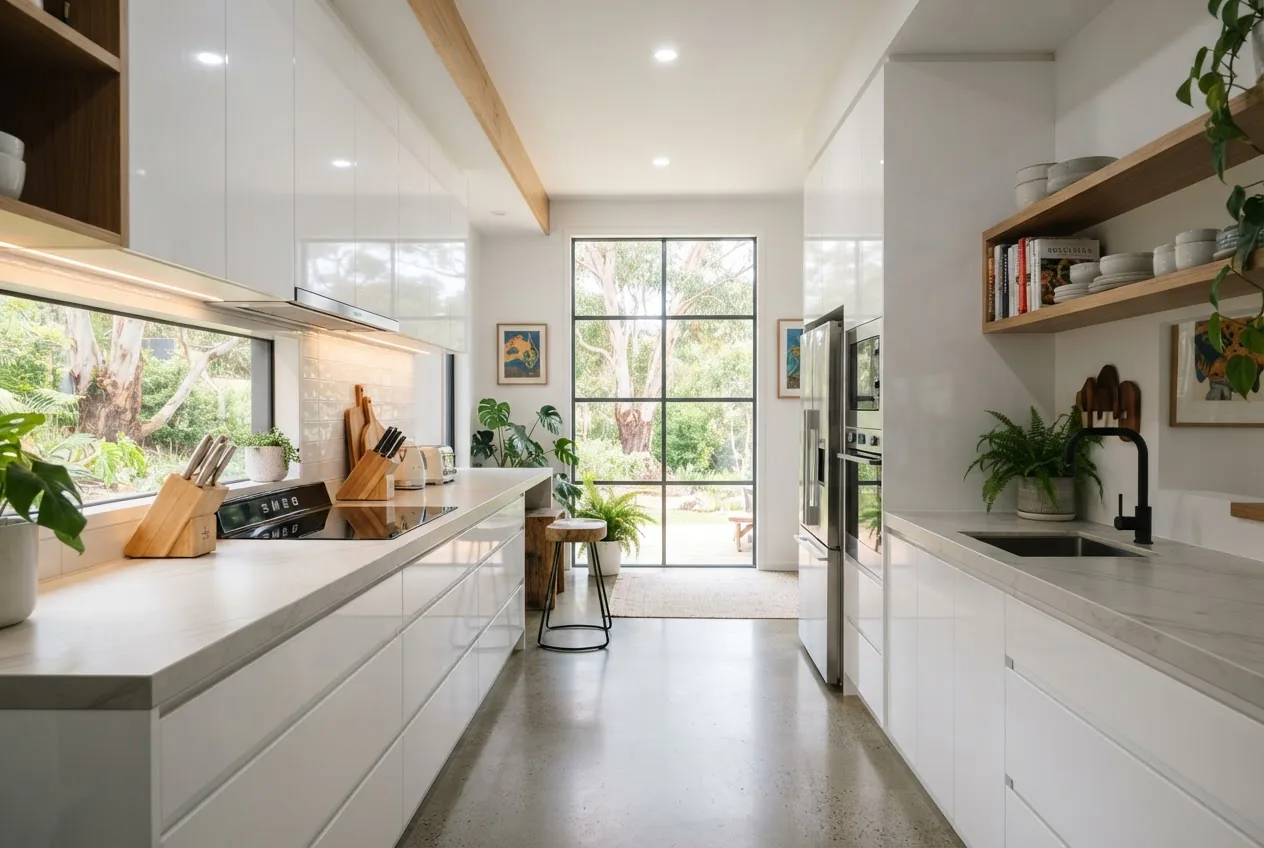
Why a galley kitchen works
A galley kitchen is a linear design with two parallel runs (or a single run with a facing island/peninsula). It’s ideal for apartments, terraces and narrow homes, but also delivers superb efficiency in new builds. With short, direct movement between prep, cook and clean zones, galley kitchen designs are fast to work in and easy to keep organised.
- Space-smart: perfect for narrow rooms and renovations where every millimetre matters.
- Efficient workflow: natural zones reduce steps and congestion.
- Budget-friendly options: less floor area can mean lower cabinetry and benchtop costs.
Core design insights for kitchen ideas for galley kitchens
Ideal dimensions and clearances
- Corridor width: 1000–1200 mm is the sweet spot for two cooks; 900 mm minimum in small galley kitchen designs.
- Benchtop depth: 600 mm standard; consider 650 mm for deeper appliances or an undermount sink.
- Walkway at appliance doors: allow 1000 mm clear in front of ovens, dishwashers and fridges.
- Rangehood clearances: follow appliance instructions and AS/NZS 5601 guidelines for gas cooktops (often 600 mm electric, 650 mm gas minimum).
Storage that multiplies capacity
- Full-extension, soft-close drawers for pots and plates.
- Pantry pull-outs, corner solutions and toe-kick drawers for hard-to-reach spaces.
- Tall appliance pantry to hide microwave, coffee machine and toaster.
- Overhead cupboards to the ceiling with a bulkhead to stop dust and visually “finish” the kitchen.
Light, colour and reflection
- LED strip task lighting under overheads to brighten the benchtop.
- Light-coloured doors and a reflective splashback (glass or mirror) to widen narrow rooms.
- Window splashbacks where possible to bring in WA sunlight and cross-ventilation.
Appliances sized for galley kitchen plans
- Ovens: 600 mm standard; 450 mm compact options save space in small galley kitchens.
- Cooktops: 600 mm induction cooktop is efficient and safe; 900 mm suits keen cooks if space allows.
- Dishwashers: 450 mm slimline or drawer dishwashers for narrow layouts.
- Fridges: consider integrated or counter-depth models to keep aisles clear.
Our renovation and design process
Joyce Kitchens designs and delivers custom cabinetry in WA for kitchens, bathrooms, laundries and wardrobes. For kitchen renovations Perth-wide and across regional WA, our approach keeps your project on time and on budget.
- Consultation and measure — We assess your space, services and goals (family size, cooking style, accessibility).
- Concept and galley kitchen layout options — Multiple kitchen galley floor plans with elevations, finishes and appliance selections.
- Selections and costing — Benchtops, doors, splashback, hardware and lighting finalised with transparent pricing.
- Compliance and scheduling — We coordinate licensed trades and follow relevant Australian Standards and guidelines (e.g., AS/NZS 5601 for gas, appliance manufacturer clearances).
- Manufacture and install — Custom cabinetry WA-made, precision-fitted with site protection and quality checks.
- Handover — Care kit, maintenance guidance and aftercare support.
For general homeowner advice, see industry bodies like the Housing Industry Association (HIA) and Master Builders WA.
Allow time in your program for selections and supplier lead times; schedules vary with scope and approvals. We provide a tailored timeline during the concept stage so you know realistic milestones from design to handover.
Materials and finishes that suit WA homes
Benchtops
- Porcelain / sintered stone — Highly heat and UV resistant, ideal for bright WA kitchens; allows slim profiles and waterfall edges.
- Laminate — Budget-friendly with many modern textures; great for small galley kitchen ideas on a budget.
- Natural stone (granite, quartzite) — Unique veining, durable; seal periodically.
- Solid surface — Seamless joins and repairable; warm touch.
- Timber — Adds warmth; oiling required and consider heat protection near cooktops.
Cabinetry
- Melamine doors and internals — Durable and cost-effective for galley kitchen designs Australia-wide.
- 2-pac polyurethane — Painted finish in any colour; perfect for a modern or shaker kitchen profile.
- Veneer or timber accents — Warmth and texture for contemporary galley kitchen ideas.
- Hardware — Soft-close drawers, finger-pull rails or a handleless kitchen with integrated profiles.
Splashbacks
- Ceramic or porcelain tiles (simple to maintain).
- Tempered glass (sleek, reflective) or mirror to visually widen small spaces.
- Stainless steel behind cooktops for commercial-style durability.
- Window splashbacks where boundary rules and privacy allow.
Comparison: Porcelain/Sintered Stone vs Laminate
| Feature | Porcelain / Sintered Stone | Laminate |
|---|---|---|
| Typical WA supply & install cost (per metre) | $$$ (higher) | $ (low) |
| Heat/UV resistance | Excellent | Moderate (use trivets; avoid direct heat) |
| Seams and edges | Minimal seams; waterfall edge possible | Visible joins; no true waterfall |
| Maintenance | Low; non-porous and stain resistant | Low; avoid sharp impact and hot pans |
| Best use in a galley | Premium, high-wear surfaces and long runs | Budget-friendly refresh and rentals |
Layouts and styles: kitchen designs for galley kitchens
Popular galley kitchen layout options
- Classic double run — Two parallel benches with cooktop on one side and sink/dishwasher opposite for efficient zone flow.
- One-wall galley + island — A galley kitchen with island facing the run; ideal for open-plan living and entertaining.
- Peninsula galley — Convert a wall to a peninsula to increase bench length and add seating.
- Galley with scullery — Hide appliances and bulk storage in a compact back room for a cleaner main kitchen.
Small galley kitchen designs and budget ideas
- Use a single, continuous benchtop to stretch the eye and simplify cleaning.
- Select 2–3 finishes max: e.g., white 2-pac doors, oak-look accents, light porcelain splashback.
- Go integrated where possible (fridge, dishwasher) to minimise visual clutter.
- Consider open shelves on one side for a lighter feel and better value.
Style directions
- Modern galley kitchen ideas — Handleless doors, matte finishes, induction cooktop, and a flush-mounted undermount sink.
- Classic shaker kitchen — Framed doors, traditional knobs, tiled splashback and warm lighting.
- Coastal Perth — White and sand tones, timber accents, and durable UV-stable benchtops.
- Industrial — Stainless splashback, concrete-look benchtop, black fixtures.
Can you add an island to a galley?
Yes—if you maintain at least 1000–1200 mm walkway around the island. In many renovations we recommend a slim island (700–800 mm deep) or a peninsula to keep traffic flowing and improve seating.
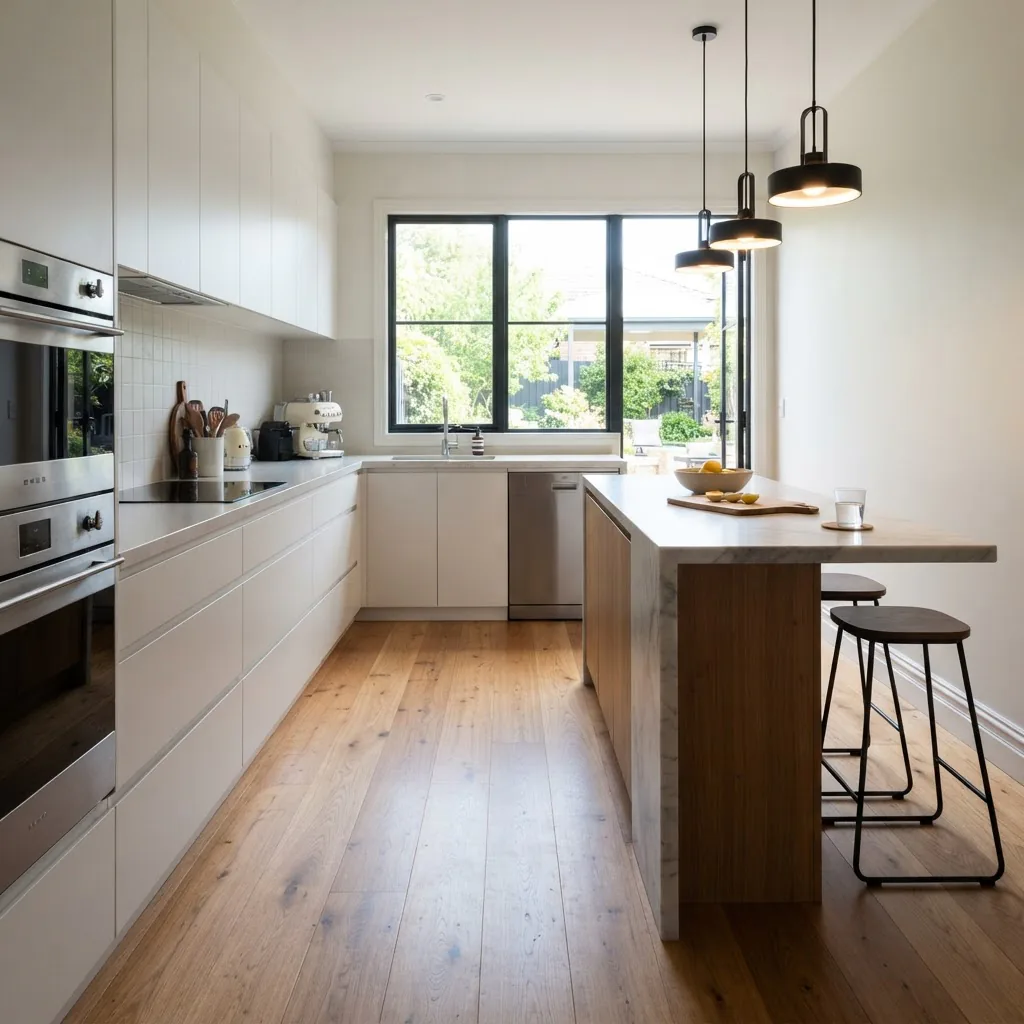
Case examples (WA)
North Perth townhouse — Narrow 2.0 m room converted to a bright galley with porcelain benchtops, full-height pantry pull-outs and a 450 mm dishwasher. Corridor widened from 860 mm to 1000 mm by recessing the fridge into a nib wall.
Fremantle apartment — One-wall galley extended with a 2.0 m peninsula for casual dining. Handleless 2-pac doors, LED strip task lighting and a compact 600 mm induction cooktop for better ventilation and safety.
Costs and budgeting for galley kitchen designs in WA
Every project is unique, but these ballpark figures help planning. Prices vary with size, finishes and appliance choices.
- Basic refresh (small galley kitchen): from $12,000–$25,000 — new laminate benchtops, melamine doors, updated splashback, existing services retained.
- Mid-range renovation: $25,000–$45,000 — mix of 2-pac/melamine, porcelain or solid surface benchtops, new appliances, improved storage and lighting.
- Premium fit-out: $45,000–$85,000+ — porcelain/sintered stone with waterfall edge, integrated appliances, custom storage and scullery.
Typical allowances
- Cabinetry and installation: the largest component in most galley kitchen designs.
- Benchtops and splashbacks: material choice drives cost.
- Trades: licensed electrical and plumbing (relocate sparingly to manage budget).
- Appliances: plan sizes early; 600 mm standards help control costs.
Tip: Check your builder or cabinetmaker follows relevant Australian Standards and manufacturer requirements. For extra guidance, consult Master Builders WA or HIA homeowner resources.
Galley kitchen planning checklist
- Confirm corridor width: target 1000–1200 mm (900 mm minimum in compact spaces).
- Choose your layout: double run, one-wall + island, or peninsula.
- Fix appliance sizes early: 600 mm oven, 600/900 mm cooktop, integrated fridge if space is tight.
- Maximise storage: soft-close drawers, pantry pull-outs, overheads to the ceiling.
- Select durable benchtops: porcelain/sintered stone for heat and UV, or laminate for value.
- Plan task lighting: LED strips under overheads; consider feature pendants at an island.
- Check code and clearances: cooktop-to-hood heights, splashback materials, ventilation.
- Consider noise and traffic: place dishwasher away from the main thoroughfare.
- Set a realistic budget and contingency (10–15%).
- Book experienced, WA-based installers for custom cabinetry and aftercare.
FAQ
What is the best width for a galley kitchen corridor?
Aim for 1000–1200 mm between the benchtop fronts so two people can pass comfortably; 900 mm is a workable minimum in small spaces.
Can a galley kitchen include an island?
Yes. Keep at least 1000–1200 mm clear around the island. In tight rooms, a slim island or a peninsula provides prep space and seating without blocking flow.
How much does a galley kitchen renovation cost in Perth?
As a guide, small refreshes start from $12,000–$25,000, mid-range $25,000–$45,000, and premium $45,000–$85,000+. Size, materials and appliance choices drive the total.
What benchtop is best for a sunny WA galley kitchen?
Porcelain or sintered stone handles heat and UV exceptionally well. Laminate is a great budget choice but avoid placing hot pans directly on the surface.
Is engineered stone still recommended for new kitchens in Australia?
No. Traditional quartz engineered stone is now prohibited nationally. Choose alternatives like porcelain or sintered stone, natural stone, or solid surface for new installations.
Standards and safety should follow manufacturer instructions and relevant Australian Standards. For safety information on engineered stone, visit Safe Work Australia.