
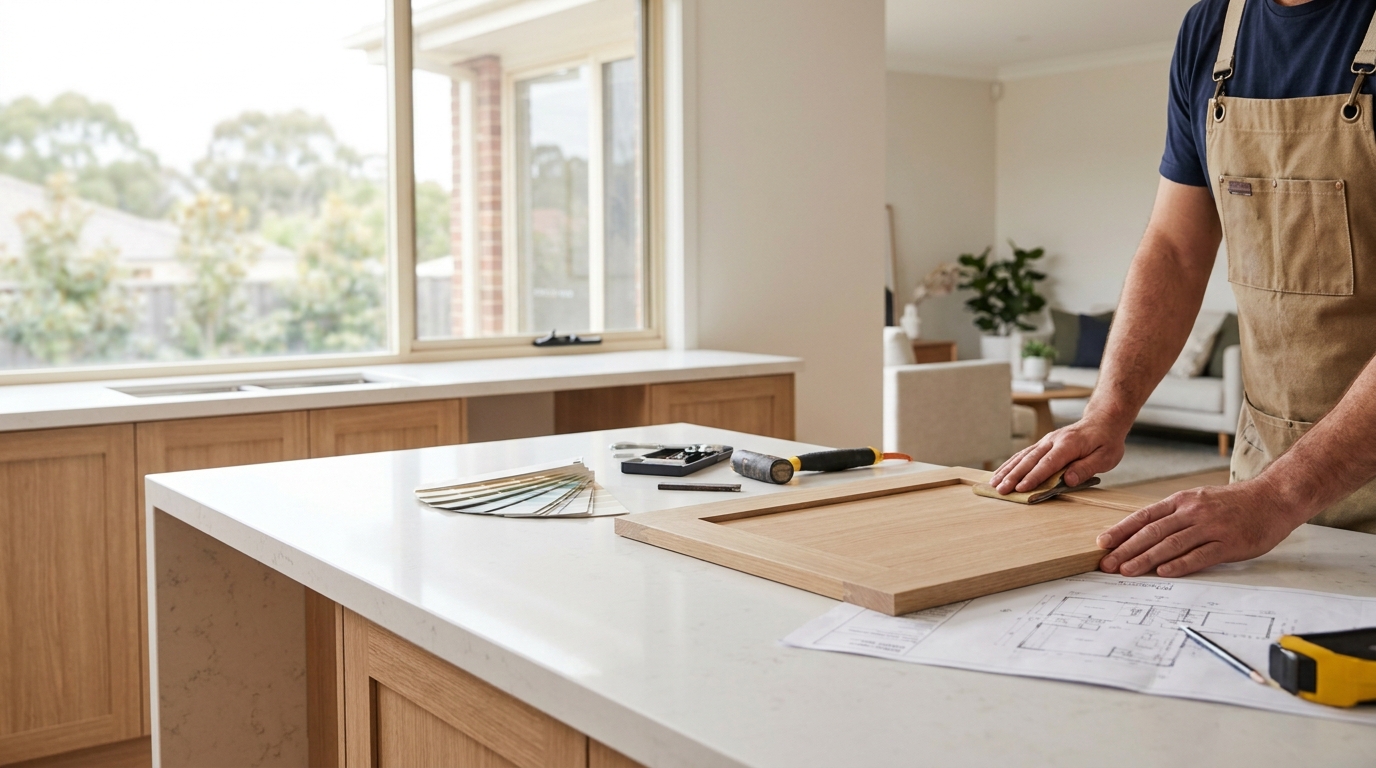
Thinking about renovating kitchen cupboards to boost functionality, add value and refresh your home? Here’s an expanded, locally-informed guide from Joyce Kitchens—Perth’s custom cabinetry specialists—covering options, costs, materials and how to get it right in Western Australia. Throughout this page you’ll find practical checklists, WA-specific compliance notes and local case studies to help plan your project.
Why renovate kitchen cupboards?
Kitchen cupboards are one of the highest-impact elements in a home renovation. Renovating cupboards improves functionality, boosts visual appeal and often increases resale value. Industry data and local agents suggest kitchen upgrades typically deliver a strong return on investment—while exact figures vary by suburb and finish, owners can often expect a noticeable uplift to perceived home value and saleability after a modern kitchen refresh.
A kitchen cupboard renovation is flexible: you can choose a purely cosmetic refresh (new doors, hardware and paint) or a functional overhaul (deep drawers, pull-out pantry and increased bench space). Practical storage improvements—like converting lower cabinets to full-extension drawers or adding a pull-out pantry—dramatically increase usable storage and reduce clutter, a key selling point for buyers.
Examples:
- Cosmetic refresh: Replace doors and handles, respray in 2-pack polyurethane, change splashback—quick impact, lower cost, typical timeframe 1–3 weeks.
- Functional upgrade: Convert base cabinets to deep drawers, add soft-close runners, install pull-out pantry and waste stations—improves daily usability and storage optimisation, often completed with minimal footprint change.
Other reasons to renovate include addressing moisture damage (installing moisture-resistant carcasses), updating to energy-efficient LED task lighting, or adapting the layout to suit modern appliances. A well-planned cupboard renovation balances aesthetics, durability and long-term maintenance—especially important in Perth’s warm, sometimes coastal climate.
Kitchen cabinet renovation process
1) Measure and assess
Start with a measured survey. Professionals measure cabinet runs, wall heights, floor levels and appliance openings. Tolerances matter—cabinetry runs are typically measured to ±2 mm accuracy to ensure fitted doors and joinery align correctly. For appliances note common appliance dimensions (600 mm and 900 mm are standard for cooktops/ovens) and allow clearance: most ovens need 5–10 mm clearance each side for trim, and island aisles should be 1,000–1,200 mm to allow two people to pass comfortably. Record hood clearances above cooktops and ventilation needs early.
2) Choose your approach
Decide whether to refresh, reface, upgrade internals or fully replace. Each has practical uses and cost implications:
- Refresh: New handles, minor repairs and a professional respray (2‑pack). Best when doors are sound but dated. Fastest and cheapest route for a visual update; see our cost of refacing kitchen cupboards guide for benchmarks.
- Reface / Replace fronts: Keep solid carcasses but install new doors, drawer fronts, end panels and kickboards. Good when carcasses are square and dry—saves time and cost versus full replacement.
- Upgrade internals: Install full-extension soft-close drawers, pull-out pantries, spice racks and waste sorting systems for functional gains without major demolition.
- Full replacement: Custom new cabinetry when you need layout changes, different cabinet heights or replacement of damaged carcasses.
3) Design details and tolerances
At design stage confirm door thickness, overhangs, end panels, cornice and plinth heights. Define appliance rebates (small framing adjustments for flush finishes), and finger‑pull, handle or handleless details. Common door thicknesses are 16–20 mm for laminates and 18–25 mm for veneered/solid timber fronts. Include appliance clearances and ventilation planning—dishwashers and ovens need accessible service gaps and ventilation for safe operation.
4) Permits & when to engage trades
Pure carpentry often doesn’t require council approval, but structural changes, moving walls, re-routing gas or major plumbing changes typically do. Engage licensed trades early for regulated work—electrical and plumbing must comply with WA rules.In practice, involve your plumber/electrician during design to confirm service locations and ensure certification after installation.
5) Manufacture, delivery and install
Custom cabinetry follows a measured package: final drawings, manufacture and a coordinated install. Typical steps include manufacture (CNC cutting, edgebanding, assembly), site delivery, site protection, sequence install (base units first, benchtop installation, sink and appliances cut-in), alignment and quality checks (soft-close operation, door gaps). Expect the fitter to leave a snag list and to return for minor adjustments after settlement.
Carcass: The cabinet “box” (sides, base, back). Often made from moisture-resistant board. Doors, drawer fronts and panels are fitted to the carcass.
Two-pack (2-pack) polyurethane: A hard-wearing painted finish cured for durability and a smooth look, common for premium cabinetry.
LeMans tray: A kidney-shaped swivel pull-out for blind corners that provides accessible storage without removing shelves.
Materials and finishes
Doors and panels: pros, cons and care
- Melamine/laminate doors: Cost-effective, durable, large colour range. Low maintenance—clean with mild detergent. Lifespan 10–20 years with normal use.
- Thermofoil / Vinyl wrap: A thin PVC film vacuum-pressed over an MDF substrate. Provides seamless curves and cost savings versus paint. Define ‘thermofoil’ early—ensure heat shields beside ovens as vinyl can delaminate near sustained heat.
- 2-pack polyurethane: Premium painted finish with excellent durability and repairability; ideal for Shaker and Hamptons styles. Requires professional application; expect a longer lead time and higher cost.
- Timber veneer / solid timber: Warm and characterful. Veneer offers timber look over stable substrates; solid timber doors can expand/contract with humidity—require sealed edges and regular maintenance.
Cabinet carcasses & moisture resistance
In WA choose moisture-resistant (MR) particleboard or MR-MDF for carcasses in areas prone to humidity. For coastal homes consider marine-grade glue and corrosion-resistant fixings. Hardware finishes (stainless steel or PVD coatings) improve life near salt air.
Hardware and internals
- Soft-close hinges and full-extension runners reduce wear and improve the user experience.
- Pull-out pantry units and drawer organisers increase storage efficiency; LeMans and carousel units reduce dead corners.
- Consider branded hardware (Blum, Hettich) for warranty and long-term reliability; typical hardware warranties are 2–5 years depending on brand.
Benchtops: WA considerations and supplier questions
Recent national restrictions on high-silica engineered stone mean homeowners must verify product compliance and installer certification. Safe Work Australia and WorkSafe WA provide guidance on handling engineered stone risks—ask suppliers for compliance certificates and installation methods.
- Sintered stone / porcelain: Sintered (engineered by compressing minerals at high temperatures) and porcelain slabs offer low porosity, high heat and scratch resistance. Define “sintered stone” as a non-porous man-made surface made from natural minerals fused under heat and pressure.
- Natural stone: Marble/granite offer classic looks but are porous (seal regularly) and can be heavy—ensure bench support from cabinet carcasses.
- Premium laminate: Modern laminates mimic stone and timber at lower cost and weight, with improved heat resistance and serviceability.
What to ask your benchtop supplier
- What is the silica content and do you provide a compliance certificate?
- Is installation by a certified fitter and what are lead times?
- What warranties apply and what maintenance is required?
- Are heat shields supplied or recommended for adjacent cabinetry?
For further reading on safe handling and current rules, see Safe Work Australia and WorkSafe WA guidance on engineered stone and silica hazards:
For comparative benchtop options and technical details, visit our benchtop material options page.
Layouts and popular styles
Smart layouts for cupboard upgrades
Your layout determines the functionality of cupboard storage. Consider typical measurements and recommendations:
- Galley kitchens: Best with uninterrupted runs and deep drawers. Maintain 900–1,000 mm between runs for good circulation when two cooks share the space.
- U-shaped kitchens: Convert blind corners to carousels or LeMans trays; pantry pull-outs work well at run ends. Keep the work triangle compact—1,200–2,700 mm between sink, cooktop and fridge is commonly targeted.
- L-shaped with island: Use the island for storage and appliances; allow 1,000–1,200 mm behind island seating for circulation. Power points on the island improve usability for small appliances.
- Butler’s pantry: Ideal for extra food prep and appliance storage; typical depth 600–1,000 mm depending on use, with shelving and task lighting for efficiency.
Style cues Australian homeowners love
- Shaker: Framed panels, typically finished in 2‑pack paint; pairs well with solid benchtops and muted hardware.
- Contemporary flat-panel: Minimal joins, handleless solutions or finger-pull rails—works with modern integrated appliances.
- Coastal / Hamptons: V-groove panels, light colours and open shelving—popular in Perth coastal suburbs but specify durable finishes for humidity.
WA case examples
Fremantle character home: Replaced flat melamine doors with timber veneer panels and finger-pull rails; slimline pantry pull‑out installed. Time: 5 weeks. Cost: mid-range custom upgrade. Client feedback: warm tone matched jarrah floors.
Scarborough apartment (new case): Compact L-shaped kitchen with island—converted lower cabinets to deep drawers, added under-cabinet LED task lighting and a porcelain benchtop. Time: 7 weeks (design to completion). Cost band: AU$20k–26k (cabinetry + benchtop).
Mandurah coastal renovation (new case): Full replacement due to water damage; used MR-MDF carcasses, marine-grade hardware and 2-pack doors. Included corrosion‑resistant fixings for coastal exposure. Time: 10 weeks. Cost band: AU$28k–35k (cabinetry + benchtop + trades).
These WA case studies highlight practical choices: refacing suits sound carcasses and shorter timelines; full replacement addresses damage or layout changes.
Costs and timelines in WA
Costs vary by scope, finishes and kitchen size. If you need a wider costing context, see our kitchen renovation cost breakdowns in WA for supply-and-install comparisons. Typical Perth ranges (cabinetry supply & install only):
- Refresh (handles + respray): AU$1,500–5,000+
- Upgrade internals: AU$2,000–7,000+
- Full custom replacement (cabinetry only): AU$18,000–45,000+ (benchtops, appliances extra)
Per-linear-metre benchmarks are useful: basic cabinetry can start from AU$1,000–1,500 per linear metre, mid-range around AU$1,500–2,500, and high-end custom can exceed AU$3,000+ per linear metre depending on doors and hardware. Benchtop costs vary: premium sintered or porcelain benches are higher than laminate but safer and more durable post-engineered-stone restrictions.
Timelines
- Small updates (refresh or minor internal upgrades): 1–2 weeks from measure to install.
- Mid projects (reface + benchtop): 4–8 weeks including manufacture and templating.
- Full custom replacements: 6–12+ weeks depending on design complexity, benchtop fabrication and trades coordination.
Allow contingency for atypical permits, benchtop lead times, and trade scheduling. Contracts commonly require a deposit (typically 20–30%) with staged payments on manufacture and completion. Standard hardware warranties are 2–5 years; cabinet finishes often carry 5–10 year manufacturer warranties depending on product.
For consumer protections and trade guidance consult HIA and Master Builders WA when contracting a builder or sub‑contracting trades.
Kitchen cupboard renovation checklist
- Confirm your goal: List 3 functional improvements and 2 aesthetic aims (e.g., deeper drawers, unified door colour).
- Photograph & document: Take elevation photos, appliance model numbers and measure existing runs—keep digital copies for designers.
- Measure appliances: Record widths (600/900 mm), depths and ventilation specs; check fridge recess and dishwasher clearances.
- Finish sampling: View finish samples in your AM and PM light on-site to confirm colour and texture.
- Hardware & internals: Choose runners, hinges and pantry systems—confirm brand warranties and corrosion resistance for coastal homes.
- Power & lighting: Mark new outlets, under-cabinet LEDs and island power locations on your plan; involve an electrician early for costs and placement.
- Contract & schedule: Get a written scope, full inclusions list, finish schedule and lead times. Confirm deposit and staged payments.
- Site access & protection: Plan dust protection, parking for deliveries and temporary kitchen arrangements.
- Aftercare: Keep care guides, warranty cards and contact details for service; schedule final sign-off with a snag list.
Ready to update kitchen cabinets? Book a free in-home measure and design consultation with Joyce Kitchens across Perth and surrounds via our booking page or call our team to discuss options and timelines.
Frequently Asked Questions
Is it cheaper to update or replace kitchen cupboards in Perth?
Updating (refresh or reface) is normally cheaper — typically 25–60% of the cost of a full replacement depending on finishes. Reface keeps sound carcasses and replaces doors/hardware; full replacement is needed for layout changes or badly damaged carcasses. Get a site measure for a precise quote.
Can I keep my existing kitchen cabinet carcasses when renovating?
Yes—if carcasses are plumb, square and dry. A professional will check for rot, water damage and square runs. Keeping carcasses saves time and money, but expect adjustments for drawer widths or modern appliance depths; factor in possible rebating or end panels for a neat finish.
How long does a kitchen cupboard renovation typically take in WA?
Small updates: 1–2 weeks (design & install). Mid projects: 4–8 weeks (design, manufacture, install). Full custom replacements: 6–12+ weeks depending on complexity, benchtop lead times and trades coordination. Allow contingency for custom finishes and council or trade scheduling.
What materials are best suited for kitchen cupboards in Perth’s climate?
Moisture-resistant carcasses, quality melamine/laminate or 2-pack polyurethane doors, and well-sealed veneered surfaces work well. In coastal areas choose corrosion-resistant hardware and sealed joins; use heat shields beside ovens. Discuss humidity and sun exposure with your designer.
Do I need council approval for renovating kitchen cupboards in Western Australia?
Pure carpentry swaps rarely need council approval. However, structural alterations, changing gas services, major plumbing or removing load-bearing walls usually do. Any regulated electrical/plumbing work must be done by licensed trades and comply with WA rules — check with your local council or builder.
What are common kitchen cupboard layouts and styles for WA homes?
Common layouts include galley, U-shaped, L-shaped with island and butler’s pantries. Popular styles in WA are Shaker (classic), flat-panel contemporary, and coastal/Hamptons. Choice depends on home character, storage needs and lifestyle — island benches for entertaining, pull-out pantries for storage efficiency.
How much does a full kitchen cupboard replacement cost in Perth?
Full custom cabinetry typically ranges from AU$18,000–AU$45,000+ (cabinetry only). Factors: kitchen size, door finish (2‑pack or veneer), hardware, internal fit-outs and benchtop choice. Request a detailed supply-and-install quote listing inclusions, lead time and warranty.
What compliance and safety standards apply to kitchen renovations in WA?
Compliance includes AS/NZS building and electrical/plumbing standards; AS/NZS 4386 is commonly referenced for kitchen assemblies. Use licensed electricians/plumbers for service work. Refer to HIA, Master Builders WA and Safe Work Australia for contracts, trade licensing and safety guidance.